

The test was mostly consistent with my expectations: relatively straightforward content wrapped in fast pacing, a handful of deceptively worded questions, and enough time pressure that stamina and focus mattered almost as much as the actual material.
The overall testing experience was fairly smooth. We started on time, and the environment itself was ideal enough for testing. There were a few small inconsistencies between what the proctor read aloud and the instructions displayed in Bluebook, which made me wonder whether the College Board is still quietly revising procedures or wording between testing administrations.
A few students arrived underprepared administratively; some did not have their admissions ticket ready either digitally or in print (I had mine ready on my phone). One student had a registration issue and ended up joining our room after the rest of us had already begun the first section. Students were told they could take unscheduled breaks during sections if necessary, though doing so would continue the timer and sacrifice testing time. Interestingly, no one in my room chose to do that, including students who finished sections early; everyone simply waited for the scheduled breaks.
Reading & Writing
This section felt mostly standard. All the vocabulary was expected, and none of the words were especially difficult to understand, even without the help of context clues. One notable detail was the repetition of specific topics—such as a particular historical context or scientific phenomenon—across different questions or sections. While this repetition didn’t necessarily shift the difficulty level, it did cause me to do a double take. It made me wonder if these various questions were all derived from the same source passage, a slight deviation from the usual variety of content.
There were a couple of transition questions that used phrases rather than singular words as transitions, which I haven’t seen too often. In some respects, I found these questions more manageable than the standard transition word version; the phrases were often less subtle than a singular transition word, which reduced my reliance on context clues. Only one rhetorical synthesis question stood out because one of the answer choices contained inaccurate information, meaning success depended less on relevance of answer and more on carefully reading the provided notes and details. While most of the answer choices appeared effective at first glance, they often incorporated details incorrectly; consequently, success required verifying logical consistency rather than simply identifying recycled information. It was the sort of question designed to punish skimming, a typically well-worn strategy for those questions.
Nothing struck me as wildly outside the norm, though the pacing of the digital format continues to make even manageable questions feel more intense. While fundamental strategies work, success requires composure and meticulous preparation.
Math
Math continued to feel fast-paced, though not necessarily overwhelmingly difficult. The more challenging questions were not clustered exclusively at the end; instead, several tougher problems seemed randomly peppered throughout the middle of Module 2, which caught me off guard somewhat. I recommend employing a strategy of skipping and returning, particularly if a student feels stalled after roughly thirty seconds; often, returning to a problem with fresh eyes after a brief mental break is what allows the logic to finally click.
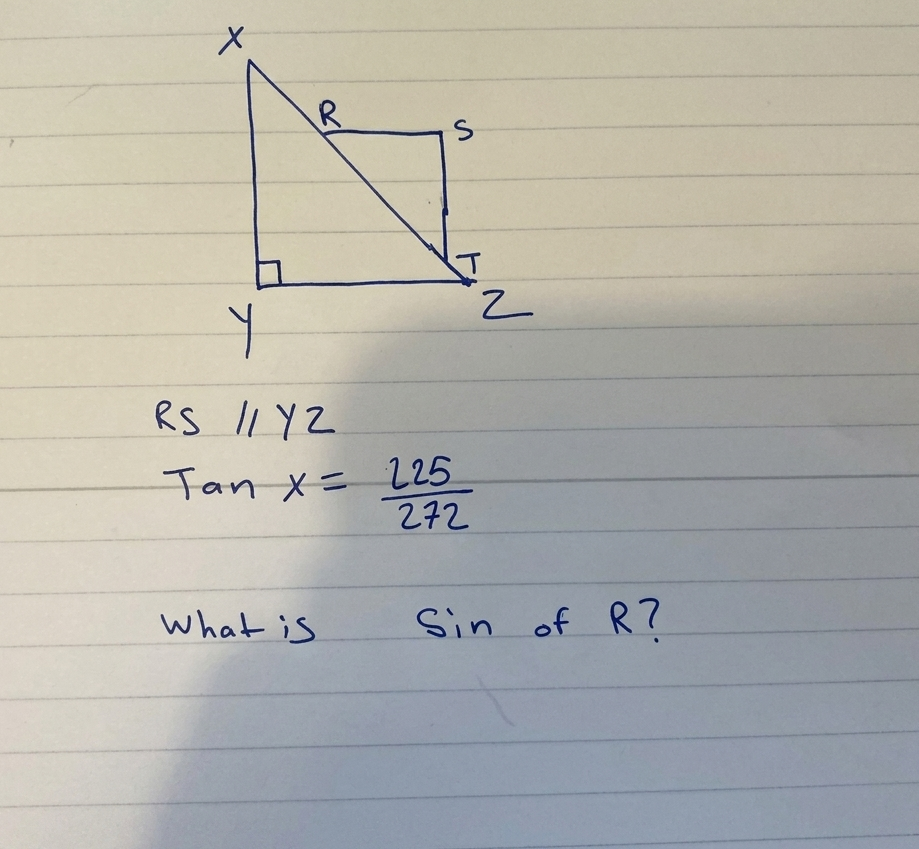
One question involved a right triangle combined with parallel line relationships and trigonometric ratios. It appeared in Module 1 and was not especially difficult mathematically, but the setup itself was less conventional than most SAT right-triangle questions.
36x^2(x+4) – 36(x+4)^3
The key was recognizing the shared factor of 36(x+4) before simplifying further.
There was also a quadratic equation question:
-5x(x+7)=15
Students had to solve for x, selecting the correct answer from a list of options.
Both these questions were time consuming and didn’t have immediately clear shortcuts from what I noticed.
Desmos remained extremely useful throughout the section. A few questions became significantly faster when using quadratic or linear regression tools rather than solving everything algebraically by hand. More than anything, many of the questions simply felt long. Even when the underlying concepts were not especially advanced, they often required enough setup and reading that time management became important.
Overall Experience
The biggest takeaway from the test was how mentally demanding the pacing feels over time. This test felt legitimately difficult. By the end, my brain was noticeably fatigued. Even though I still wanted to work carefully through the remaining questions, the temptation to mentally “phone it in” and simply finish the test became pretty strong. Some of that may have been because the stakes for me were relatively low outside of personal pride, but I can easily imagine students experiencing that same exhaustion under real score pressure.
The digital SAT continues to feel very fast. The challenge is not always the difficulty of individual questions, but rather maintaining attention, accuracy, and composure continuously across the entire exam.